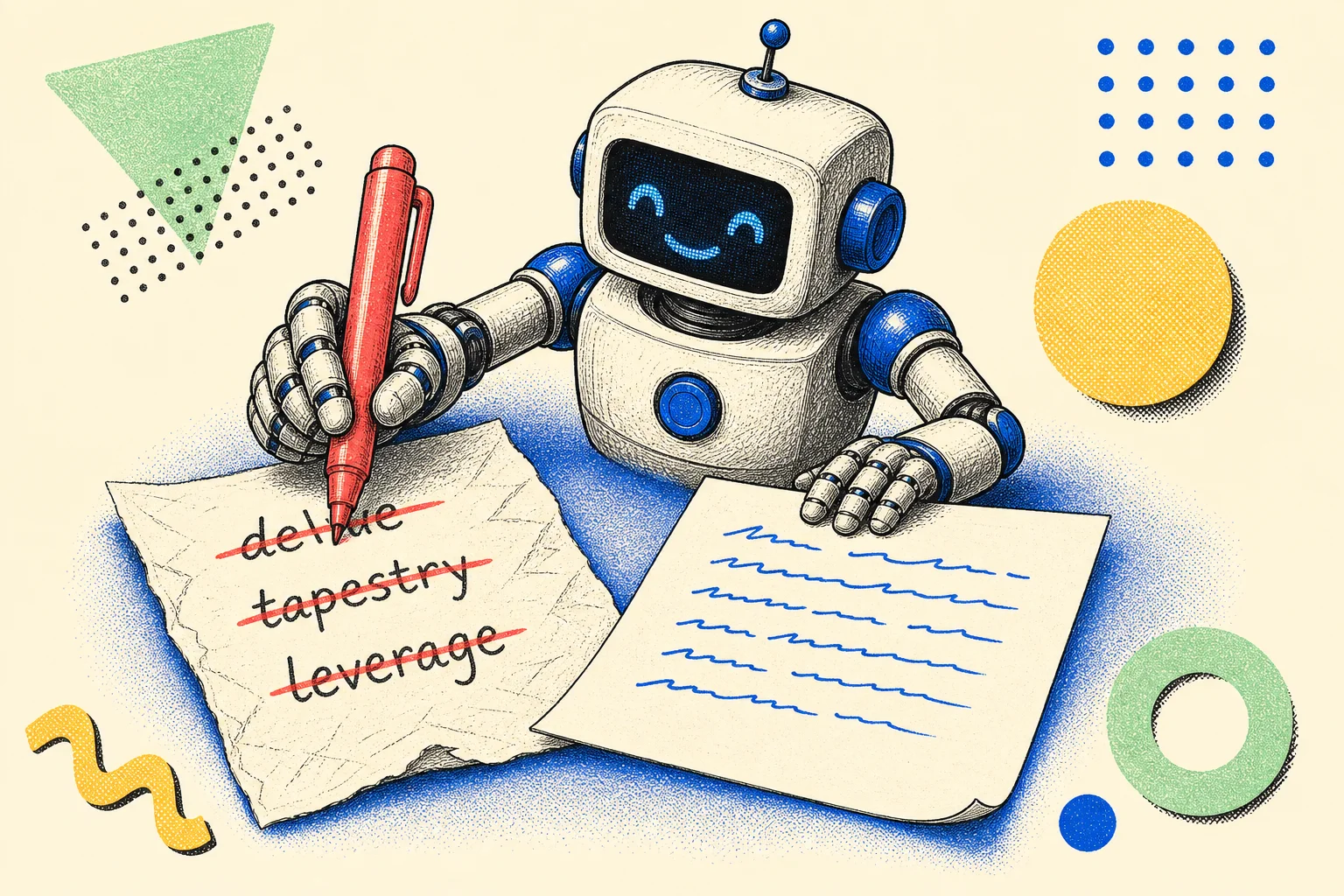
Here's the dirty secret of AI “humanizers”: most of them swap “delve” for “explore”, kill a couple of em dashes, and call it a day. That's find-and-replace with a marketing page.
So I built Slopbuster, starting from a different question: how does AI text actually differ from human text? Not just the obvious words, but the rhythm, the structure, the tells that show up in code and academic writing too. Then I turned the answer into rules.
Slop is more than a word list
The “delve” meme is real but shallow. AI writing has deeper tells: it dodges the word “is” (serves as a testament to), forces everything into threes, stacks hedges, opens and closes paragraphs the same way, and sprinkles em dashes like punctuation confetti. Slopbuster catches 100+ of these across prose, sorted into content, language, style, communication, and structure.
Two passes: remove the slop, then add the soul
This is the part that matters. Strip the AI patterns and you don’t get human writing, you get sterile writing, which is just as detectable by a different classifier. So Slopbuster runs a second pass that puts voice back in: varied rhythm, specifics instead of vague references, an actual opinion. The first pass removes the slop.
The second adds the soul.
You can watch it climb. A stock corporate sentence scores about 3.8 out of 10. After the first pass it’s a 6.2 (clean, but flat). After the second it’s an 8.4, with concrete examples and a point of view. Target 8+ before anything goes public.
The part nobody else does: AI code has tells too
Text humanizers stop at prose. But AI-generated code has its own fingerprints: comments that narrate the obvious (// increment counter), variables named like userDataObject, commits that just say “improve” and “various,” docstrings that restate the type signature, functions that come out suspiciously symmetrical. Slopbuster ships 80+ code patterns across comments, naming, commits, docstrings, quality, and structural tells. As far as I can tell, nothing else does this.
Not all tells are equal
“Delve” is a dead giveaway. “Additionally” is just suspicious. So the scoring is weighted: Tier 1 (3 points) for the smoking guns, Tier 2 (2 points) for corporate tells like “leverage” and “synergy,” Tier 3 (1 point) for weak signals like “Furthermore.” It adds up to a 0–10 human-ness score, so “this feels AI” becomes a number you can actually move.
Built on research, not vibes
The rules come from analyzing 1,000+ AI-versus-human writing samples and cross-referencing peer-reviewed LLM-detection research (Kobak et al. 2025, Liang et al. 2024, Juzek & Ward) plus Wikipedia’s “Signs of AI writing.” It’s a method with sources, not a hunch.
Runs anywhere, nothing leaves your machine
Slopbuster is pure markdown. No runtime, no dependencies, no API calls. One command installs it (npx skills add gabelul/slopbuster) and it works in Claude Code, Codex, Cursor, and 50+ other agents. Wire it into your agent config and it applies the rules to everything it writes, not only when you ask.
Generate fast, then verify with evidence
Slopbuster is one of a pair. Pixelslop catches visual slop, the generic AI-built interface, by measuring the rendered page. Slopbuster does the same for the written word and for code. Same idea either way: AI gets you to a draft fast, then you verify against something real before it ships.
If you write with AI in the loop and you’re tired of recognizing your own output by its tells, the repo’s below. MIT, no API, no catch. Happy to talk through where it fits if you’re wrestling with the same problem.